
When applying for a cash loan, most people immediately think of their credit history, or credit score, as the most important factor.
However, due to a combination of government regulation and digitised loan assessments, lenders will usually examine your bank transaction data.
This can be a huge benefit to you if your credit score is a bit low, and you are now managing your budget well.
In this article, we’ll discuss what lenders are looking for in your statements and what is considered high risk behaviour.
Why Bank Statements Can Help Those with Bad Credit
Your credit history goes back five years and it can take a long time to rebuild your credit score.
So if you have past blemishes, such as a default, they will be visible for a long time.
Gusto Cash will assess your current financial behaviours rather than penalising you for a mistake that happened many years ago.
Bank statements are one element of this assessment that provides great insight into how you are managing your money today.
Your bank statements are constantly evolving and this allows you to evidence positive financial habits in less than 90 days, no matter where you are starting from.
This is a big advantage for those who have fixed their credit problems, need a loan now, but are waiting for their credit score to catch up!
What Lenders are Looking For
Below is a summary of the data points they will look at, and what questions they are trying to answer:
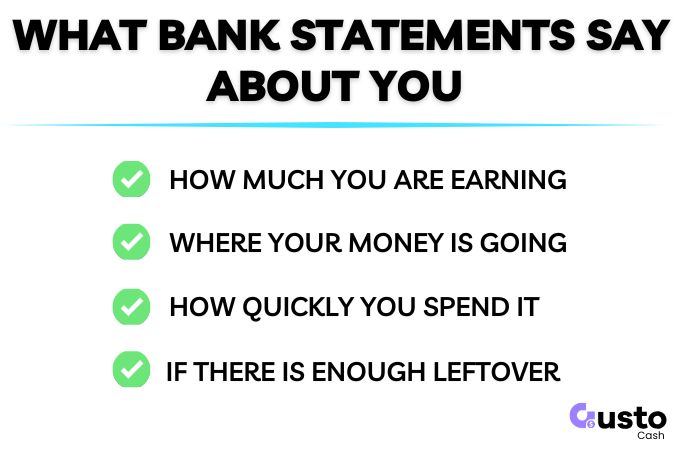
- Income data: How much are you earning?
- Transaction data: Where is your money going?
- Serviceability: Is there enough leftover to make the repayments?
Most lenders will require 90 days’ worth of bank statements from your main transaction account.
This means the account your salary is paid into, and where you do most of your spending.
If you are using multiple accounts to manage your bills then this could slow down your application, or misrepresent your finances which could lead to a declined application.
However, it is very common for people to utilise more than one bank account.
This shouldn’t derail your application as long as you are transparent and not actively trying to hide things.
Some common mistakes that will hold up your application include:
- Transferring a large portion of your money to another account to pay expenses.
- All spending is done from a joint account.
Both of these scenarios limit the reliability of the data in your statements.
Income Data
If you are a regular full-time employee, then demonstrating consistent earnings will be easy.
However, if you are casual or rely on commissions or overtime, then there may be some additional explanation required.
Providing additional information such as payslips can ensure that your earnings are being calculated correctly.
Especially if there is a one off problem that has affected your earnings. Such as a period of unpaid leave.
Transaction Data
Your transaction data says a lot about how much of a credit risk you are.
In fact, any red flags detected in your expenditure is the quickest way to get declined.
For example, if you are depositing money into your online betting account multiple times at 3am on a Sunday morning, then this could raise the alarm that this person is a credit risk.
Or perhaps your last three mortgage or rent repayments have reversed? Huge red flag!!
There is more to it, of course, but these are easy-to-understand examples from a lender’s point of view.
A lender will categorise your expenses into the following categories:
- Basic living expenses – Essentials like your rent, food, and utility bills.
- Discretionary expenses – Optional costs like eating out or your Netflix subscription.
- Liabilities – Your repayment obligations to other lenders.
Now, you may be thinking that you could simply spend from your savings in a different account for 90 days and you could present your expenses as almost nothing… Incorrect!
As part of the credit legislation, all lenders are required to use living expense benchmarks to check that your expenses are credible.
If you underdeclare your expenses, then they will be raised anyway to a reasonable household budget level.
Where you can make a difference is with your discretionary expenses and liabilities.
The best way to minimise the expenses included in your application is to minimise what you spend on unnecessary stuff in that 90-day window.
There is less wiggle room with your liabilities unless you have a loan that will be paid out soon.
You may be better off just waiting until that final payment is made before applying for additional credit if you cannot comfortably afford the repayments today.
A lender is obligated to include that repayment in your expenses, even if you only have two left to go!
It’s in the legislation, so you will get no flexibility there.
Loan Serviceability
The basic formula for calculating your capacity to service the loan is your income minus expenses minus liabilities must equal more than your loan repayment.
What you won’t see is that most lenders also require an additional buffer in your budget.
This amount is applied behind the scenes when calculating if you can afford the loan.
A buffer could be $100, or it could be $400 a month. And you’ll need to demonstrate that you can afford the repayment + the buffer!
This is done to make sure that you can absorb any unexpected changes in your financial situation and still be able to make your repayments.
High Risk Spending Patterns
Some transactions can hurt your application no matter how healthy your account balance looks at the end of the week.
One high risk transaction is unlikely to do much damage to your application. Your regular spending patterns are generally more important.
Some examples of higher risk transaction that may signal financial stress include:
- Frequent gambling transactions.
- Repeated overdrafts or dishonour fees.
- Regular use of short-term wage advance apps.
- Heavy Buy Now Pay Later spending acting as ongoing commitments.
- Large, unexplained cash deposits used to prop up an empty account.
A combination of these factors can indicate that you are not ready to take on additional debt and you need to get your financial house in order first.
Frequently Asked Questions
How many bank statements do lenders usually require?
Most lenders (including Gusto Cash) will require 90 days of transaction history as part of your loan application.
Is linking my bank account to a lender safe?
Yes, the data is provided through a portal that links you directly to your bank. Your login credentials are not shared with the lender and it is only the transaction data that you have authorised with the bank that is shared.
Will gambling or wage advance apps decline my loan?
It will depend on the frequency of use, dollar amounts involved, and the spending patterns. These are just two examples of high risk transaction that can lead to your loan application being rejected. For example, moderate levels of recreational gambling may be ok if you can still afford your repayments comfortably.
Preparing Your Personal Loan Application
If you have read this article and identified areas where your bank transactions may appear as a negative, then the good news is that you can clean them up in only 90 days or less!
Any improvement in your financial habits will benefit you over the long term, while also improving your prospects of future credit.
Having said that, you may be in a better position than you think.
If you need fast cash then click below to get started and our team will be in touch.