
Nothing will kill your personal cash loan application faster than a high volume of gambling deposits to your favourite bookie.
Aussies love a punt, and as long as you gamble responsibly and within your means, your application should be unaffected.
However, did you know that frequent cash withdrawals could also be interpreted as gambling transactions?
You may unknowingly be waving red flags where there are none.
In this article, we’ll discuss what is considered a gambling transaction by a personal loan lender, how they assess your bank statements, and at what point it becomes a problem for your loan approval.
Why Cash Lenders Care About Gambling
Every application for a MACC personal loan requires you to submit 90 days’ worth of bank statements.
Because cash lenders are often lending unsecured funds over a shorter period (up to 2 years), they scrutinise your daily spending habits closely.
There are two main reasons why a lender will examine gambling transactions on your bank statements.
1. Risk Assessment
A potential problem gambler is a greater risk for a lender of future default. Which goes without saying.
Excessive and frequent gambling is a strong indication that you are not managing your household budget well, and lenders will consider this when processing your application.
2. Responsible Lending Laws
Australia has strict rules on who lenders can and cannot give money to, especially around potentially vulnerable consumers.
A problem gambler with obvious compulsive patterns could be in this category.
So all lenders have strict thresholds for what is considered a reasonable amount of gambling before it may be considered a problem to ensure compliance with the regulations.
3 Signs You May Be Flagged as a Vulnerable Consumer
To be considered a problem gambler, there must be a pattern evident in your bank statements.
If you like to have a big bet once a year on Melbourne Cup Day, this will not indicate a pattern.
Even if you drop half your wage on a horse.
But if you do that every weekend throughout the 90-day statement period, it indicates a pattern of behaviour.
Let’s consider some common scenarios that may cause a lender to decline your loan.
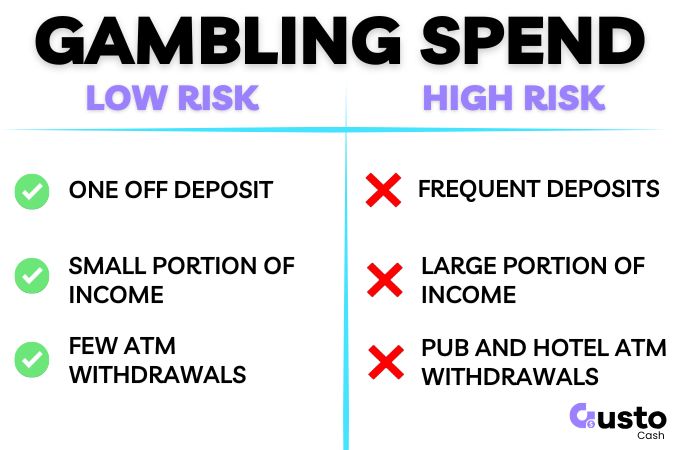
Sign 1. A Large Portion of Your Income is Spent on Gambling
Regular gambling is not necessarily a problem if you can easily afford it.
A high-income earner can gamble more than the average punter without it affecting their ability to meet their financial obligations.
Therefore, lenders will assess the acceptable portion of your income very differently depending on your income level.
If you earn $1,000 a week and gamble $400 a week, your application is more likely to be declined as this is a very large percentage of your take home pay.
Sign 2. Repeated Gambling Transactions in Short Windows
Coming back to our Melbourne Cup Day example.
Let’s consider the following sequence of events and how it may appear to a lender’s automated statement scraper:
- You deposit $100 in your TAB account for the big race.
- You get a hot tip in race 3, so you deposit another $50.
- The tip loses. You deposit another $50 to bet a few dollars in each race to pass the time.
- You deposit another $50 later in the afternoon.
We are now up to four deposits in a single day. All harmless fun in the context of Melbourne Cup Day, but remember, a lender doesn’t know the story behind the transactions.
What they see is a pattern of: deposit -> loss -> deposit -> loss.
A single day like this is likely fine. But if this pattern repeats every weekend, you are getting close to 50 gambling transactions over your 90-day statement period!
Sign 3. Repeated Cash Withdrawals
Excessive cash withdrawals can be problematic for the same reason. Just replace the TAB app with poker machines.
Have you ever been to an ATM four times in one night? Most people haven’t, and it looks very suspicious on a bank statement.
Lenders know that people doing laps between the pokie room and the pub ATM exhibit this exact behavior.
It is in the lender’s best interest to assume the worst when someone is making repeated, rapid ATM withdrawals, especially late at night.
What Transactions Count as Gambling?
Gambling transactions are identified by the merchant information included in your bank statement.
For example, it is easy to see that the transaction below is related to gambling: POS W/D Sportsbet Fis-12:13 -$200
The most common categories of gambling transactions flagged by lenders include:
- Online bookmakers (Sportsbet, TAB, Ladbrokes, etc.)
- Online casinos and slot apps
- Lottery tickets (Powerball, Oz Lotto, etc.)
- Cash withdrawals within known betting venues (Pubs, Casinos, RSLs)
- High-frequency cash withdrawals
Incorrect Gambling Transaction Identification
Mistakes can happen when processing a high volume of transactions.
If you frequently withdraw cash to pay for legitimate, cash-only services, a lender’s software might flag you for high-frequency cash withdrawals and assume gambling.
If you use mobile app betting simulators that require real money deposits, these will be treated exactly like real gambling, even if there is no chance of a cash return.
Frequently Asked Questions
Is there a specific dollar amount of gambling that will get me declined?
No, there is no universal dollar amount. Lenders look at the percentage of your disposable income spent on gambling and the frequency of the transactions. Spending 5% of your income on a few bets is vastly different from spending 30% of your income across 60 different transactions.
Can a broker or lender remove gambling transactions from my statements?
Absolutely not. Bank statements must be submitted in their original, unaltered format (usually via secure digital scraping). Any attempt to hide or alter bank statement data could also be considered fraud.
Does buying weekly lotto tickets count as gambling?
Yes, buying lotto tickets is a form of gambling. However, if it is a consistent, low-cost expense (e.g., $15 a week) that easily fits into your budget, lenders will simply categorize it as a standard recreational expense, and it will rarely affect your approval.
What if I win more than I lose? Does that help my application?
Lenders do not care if you are a winning punter. Gambling income is highly speculative and will never be counted as assessable income. Furthermore, heavy gambling still demonstrates high-risk financial behavior and can still lead to a declined application.
How to Fix Bank Statements with Excessive Gambling
If you think your gambling expenses may prevent you from being approved for a personal loan, the good news is you can overcome this problem within 90 days.
However, your first priority must be to consider if you have a genuine problem with gambling and if you need help.
Contact the following government services for assistance:
- Assistance to overcome gambling addiction: gamblinghelponline.org.au
- Self-exclusion from betting services: betstop.gov.au
If you are a casual punter and just want to improve the quality of your personal loan application, you can apply the following tips:
- Take a 90-day break from all forms of betting. This is the fastest way to tidy up your bank statements before applying.
- Deposit in one lump sum. If you still want to have a bet, set a strict budget. Deposit your budget into your betting account in one single transaction per pay cycle, rather than 10 small deposits throughout the weekend.
Presenting a Responsible Budget Manager
The risk of writing an unsuitable loan is significant for a MACC lender, and they will not give you the benefit of the doubt if your statements are chaotic.
This is a good thing as problem gamblers should not be getting themselves into further debt.
But if you are a recreational punter who can enjoy things responsibly, you now know how to ensure you present an accurate, low-risk picture of how you manage your finances.
If your bank statements are looking clean and you need a cash loan between $2,001 and $5,000, the team at Gusto Cash is ready to help!