
It can often be a mystery why a lender has declined your personal loan application, and most will be quite vague even if you ask.
Rather than looking for certainty, understanding all the potential failure points may help you self assess where you can improve your risk profile.
In this article, we’ll discuss 9 of the most common reasons a personal loan application will be rejected.
9 Reasons your Personal Loan was Declined
No two lenders are the same and there could be a combination of factors holding you back with one lender, whereas another may be willing to approve your loan.
To check your eligibility for a Gusto Cash personal loan click below to get started.
1. Loan Serviceability and Living Expenses
Lenders are obligated by responsible lending laws to look at your budget and whether you can comfortably afford the loan additional repayments.
They will consider the surplus cash left over after all living expenses and existing commitments are paid.
If your bank statements show high levels of spending then this could also erode your surplus.
Even if that expenditure is discretionary.
2. Negative Entries on Your Credit Report
Your credit score is one of the most influential elements in a personal loan application.
Most lenders have a minimum threshold, and if you are below this your application will go no further.
But did you know the contents of your credit report is also just as important?
Entries can provide important context behind the number, highlighting risk areas and past difficulties.
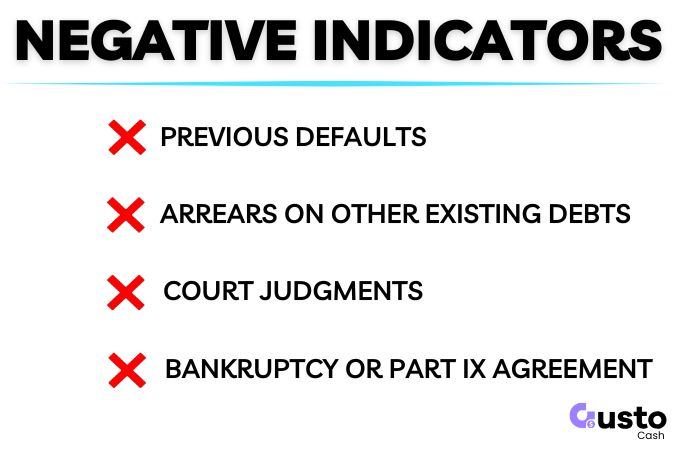
Common triggers include:
- Missed payments or heavy arrears
- Defaults and court judgments
- Bankruptcy or Part 9 debt agreements
3. Too Many Recent Loan Applications
A series of loan applications in a short space of time can indicate there is a problem.
Your credit score will also take a hit each time.
Most lenders will automatically decline a personal loan application if the number of recent other applications exceed a certain threshold, within a set period of time.
Your credit score will recover quickly from one application. But 4 or 5 in a short period could take far longer.
4. Wage Advance Apps
Regular use of wage advance services is a red flag for lenders as it generally indicates either poor budgeting, or a sign of financial stress.
Some patterns that may be of concern include:
- You use a salary advance in frequent pay cycles.
- Your next pay is largely spent before you receive it.
- You advance cash for food, fuel, or utilities.
While wage advances bypass your credit file, they are visible on your bank statements.
Most lenders will automatically decline repeat users.
Even sub-prime lenders will reject those with more than a couple of uses within a set period of time.
If you are stuck in this cycle it may be time to explore alternatives to wage advances and break the pattern.
5. Buy Now Pay Later (BNPL)
With credit checks now mandatory for new BNPL accounts, a lender is going to see if you have multiple accounts open.
Even if you have no outstanding payments you could be worse off with some lenders assuming your credit limit as an amount owed for their internal assessment.
This reduces your surplus income and can lead to your personal loan application being rejected.
To improve your approval chances:
- Pay down balances and close unnecessary account limits.
- Cease BNPL spending for 90 days to build a clean banking pattern.
6. Poor Bank Account Conduct
Even if your income is high, a series of high risk spending patterns could lead to a rejection.
A lender may scrutiny your statements for things like:
- Dishonoured direct debits or overdrawn accounts.
- Heavy gambling or repeated cash withdrawals.
- Missed rental payments.
These signals suggest instability at best, and potentially hardship risk.
You’ll need to improve your budget management prior to taking on any additional finance.
7. Income Verification and Documentation Failures
A common reason why your personal loan was rejected is because your documentation was either incomplete, or misrepresented your financial position.
This can be particularly difficult for those who rely on bonus income, or overtime, and have an inconsistent earning pattern in their bank statements.
When you have additional income that may not be captured in your deposits you should discuss this in your verification call and be prepared with evidence such as payslips.
Some other examples of variable earnings could be someone working as a casual employee.
A variation in hours, or a period of unpaid leave, could under-represent their income and lead to a decline if it is not addressed early.
8. Low Employment Tenure
If you have just started a new job you may find it hard to get a personal loan with some lenders.
This can also vary depending on whether you are a full time, or casual employee.
Each employment category will have a different minimum threshold and you can also get different outcomes between lenders.
Some will be more accommodating if you have stayed in the same industry for a long time, and there was no gap between your last job.
Stable income is the primary concern of the lender.
9. Lender Policies and Internal Scorecards
All lenders have their own set of criteria that must be satisfied before a loan can be approved.
There is a large variance between a low rate bank personal loan, and a short term cash loan.
A rejection may just be caused by your profile not matching the lender you have applied with.
You may need to target a different lender in your next application.
How to Fix Your Credit Profile and Reapply
The roadmap to improving your credit profile is to do the opposite of each of the 9 points mentioned above.
The time required will depend on how many of these reasons could be holding you back, and how bad the damage is.
Even a bad credit report can be improved over time with a disciplined approach applied consistently.
Some basic tips to improve your prospects include:
- Repay any accounts that are in arrears or have been defaulted.
- Ensure you have surplus cash at the end of a pay cycle and save some of this.
- Reduce any reliance on Wage Advances or BNPL.
- Cut out any unnecessary expenses if you are struggling to achieve the above.
You may be in a position to apply elsewhere sooner than you think if you find the right lender.
Frequently Asked Questions
How long should I wait before applying again?
If you have been declined by a mainstream lender and are considering a short term loan then you may be ok to apply immediately. However, as a general good practice a 30 to 90 day buffer between applications avoids the potential implications on your credit file. You can use this time to improve your risk profile.
Does being declined for a personal loan hurt my credit score?
A hard enquiry made during the application process will temporarily cause your score to dip. While one enquiry has a minor impact, multiple applications in a short period can significantly lower your score and lead to automatic rejections.
Should I close BNPL accounts (Afterpay or Zip) before applying for a personal loan?
You do not necessarily need to close accounts, but you should clear balances and reduce limits. High Buy Now Pay Later limits are treated as existing debt, which reduces your serviceability.
What if I Need Cash Fast?
If you have been rejected for a regular personal loan, you might still qualify for a short term loan offered by Gusto Cash.
With fast processing times and same day deposits you can be funded in no time.
Click below to check your eligibility and the team will be in touch.