Juggling payday loans, wage advances, and Buy Now Pay Later (BNPL) payments can create continuous cash flow stress.
The more payments you are managing the greater risk of something being forgotten, and your credit file being ruined.
While a MACC loan can simplify your payments into a single facility, it remains a high-cost credit product.
It only makes sense to consolidate your debts in this manner if the numbers genuinely work in your favor.
In this article, we outline the rules of consolidation, provide practical examples, and give you a clear guide to know when and when not to follow though.
How to Qualify for a MACC Loan
A Medium Amount Credit Contract (MACC) is a regulated loan category in Australia covering amounts between $2,001 and $5,000.
To get approved, you must meet the following eligibility criteria:
- Requirements and Objectives: The loan characteristics must satisfy your desired outcome.
- Affordability: You must be able to demonstrate you can comfortably afford the loan, and can make repayments without substantial hardship.
- Credit Rules: You will also be assessed against the internal credit rules of the lender.
Where a debt consolidation loan assessment may differ is in how your existing debts are treated in the affordability calculation.
You will have to specify what debts you are planning to repay so this can be offset against your new repayments.
Does Debt Consolidation Make Sense For You?
Moving to a new loan simply for the convenience of one repayment is not always the best financial move.
Before you take this step you should be clear on your goals for doing so, and understand how to calculate if you will be better off or not.
The change is going to impact two main financial outcomes.
Cash Flow and Repayments
Some people will consolidate their debts to get out of an endless cycle of short term loans.
If you are a regular user of wage advance apps you may know the feeling. You borrow to plug the gap until the next payday, only to be left short again and again.
While a MACC loan can be an expensive option, it can help break the cycle by removing that repeat use of these apps and the cost that goes with it.
Moving to a single repayment, and spreading out the principal over a longer period of time, allows you to get your regular budget back on track.
The downside is that the longer the loan term, the higher your total cost.
Total Cost
Ideally the consolidation will result in lower overall cost compared to your current situation.
Otherwise, you are often better off just paying down your debts as they are and weaning off them over time (if possible).
However, there are some circumstances where you will save money by moving to a MACC loan.
Even though the establishment fee and interest rate can be high.
For example, if you are closing any of the following type of products:
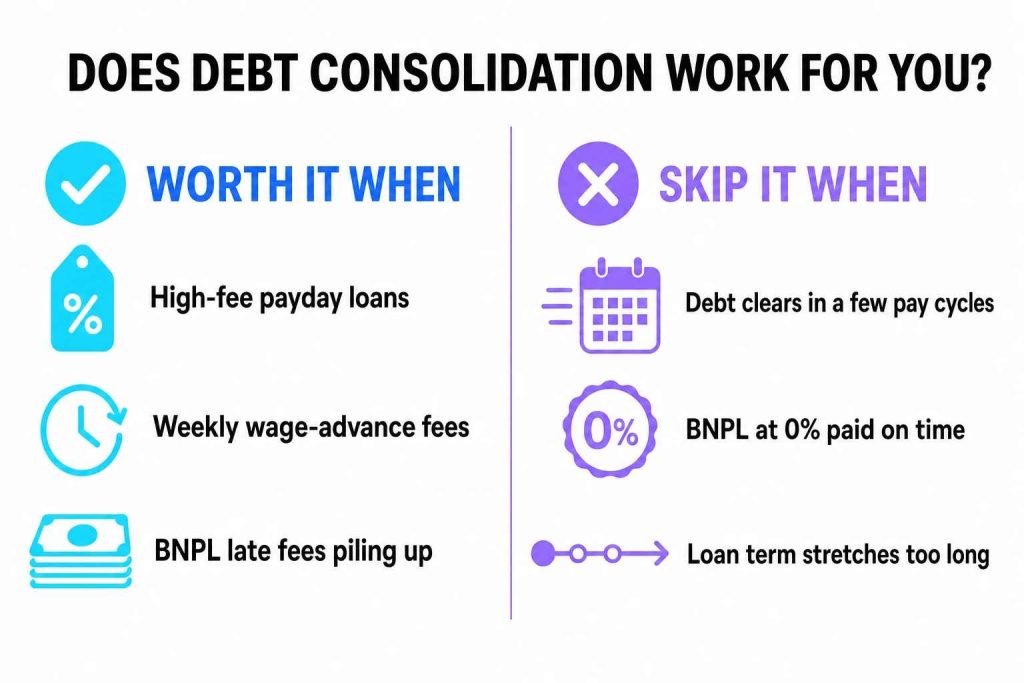
- SACC Loans: A 4% monthly fee is charged, rather than an interest rate. So the fee does not decline as you repay the principal.
- Wage Advances: Marketed as a low fixed fee cost, but if you are paying this every week on 4 different services it adds up!
- Buy Now Pay Later: You are incurring regular late fees and are struggling to catch up.
If you can access more mainstream credit products, such as a regular personal loan then this will be a cheaper option than a MACC.
How to Calculate Your Options
To determine if consolidation will leave you financially ahead, you must build a comprehensive debt inventory.
Do not guess these figures. Contact each creditor to obtain an official payout quote (the exact amount required to close the account today), and look up your remaining obligations using the framework below:
To compare both pathways you need to start by adding up all remaining scheduled repayments and fees on your current debts.
You should also get a payout estimate for each account if the account were to be closed today.
| Creditor Name | Debt Type | Payout Amount Today | Remaining Term | Remaining Interest & Fees |
| Example Company | Payday Loan (SACC) | $1,000 | 3 Months | $120 (4% monthly fees) |
| TOTALS | — | $1,000 | — | $120 |
Once you have summed up your current payout amounts and remaining fees, you can compare them directly against the cost of a proposed MACC contract (New Principal + $400 Establishment Fee + Total Contract Interest).
Debt Consolidation Example
Let’s look at a realistic scenario. Imagine you are a casual worker managing four separate micro-debts.
Your current weekly and fortnightly obligations are causing budget stress, and you want to know if a 12-month MACC consolidation loan makes sense.
First, let’s map out the total cost of your current path (continue repaying your debts):
Current Path
| Creditor Name | Debt Type | Payout Amount Today | Remaining Term | Remaining Interest & Fees |
| Creditor 1 | SACC (Payday Loan) | $800 | 3 Months(4% of original $1,500 loan) | $180 |
| Creditor 2 | SACC (Payday Loan) | $1,100 | 4 Months(4% of original $1,500 loan) | $240 |
| Creditor 3 | Wage Advance | $300 | 1 Month | $15 |
| Creditor 4 | BNPL Balance | $1,000 | 2 Months | $80 (Estimated late fees) |
| TOTALS | — | $3,200 | — | $515 |
Total Cost of Current Path: $3,715 ($3,200 principal + $515 fees)
This is to be repaid over the next 1 to 4 months with the total repayments being up near $1,000 each month to meet your obligations.
Now, let’s look at the scenario after refinancing to a Gusto Cash Debt Consolidation Loan.
To wipe out these debts, you apply for a $3,200 MACC loan.
A standard $400 establishment fee is added, making your starting loan principal $3,600. This is repaid over a 12-month term at a 47.8% p.a. reducing interest rate.
Debt Consolidation Path: Gusto Cash 12-Month Facility
| Loan Component | Cost Structure | Total Dollar Metric |
| New Loan Principal | $3,200 (Cash to clear old debts) + $400 Setup Fee | $3,600 |
| New Monthly Repayment Size | Structured reducing balance over 12 months | ~$383 per month |
| Total New Interest Charged | 47.8% p.a. calculated on the reducing principal | ~$996 |
| Total Cost of MACC Path | Principal ($3,600) + Total Interest ($996) | $4,596 |
The Cash Flow Benefit
Your immediate monthly repayment size drops from a challenging ~$1,000+ per month payment down to a manageable $383 per month.
This is important if the larger repayment obligation is likely to lead to further use of short term credit just to make ends meet.
The smaller repayment allows you to break out of that cycle.
Total Cost Trade-off
Because you are stretching the debt over 12 months instead of 4 months, the total cost rises from $3,715 to $4,596.
This is $881 in additional costs over that period.
However, this difference only accounts for the debts that are currently open and not any additional loans you may require over that same 12 month period.
If you were to renew just one of those $1,500 SACC loans, this would include a $250 establishment fee and $50 monthly fees for the duration of the payment period.
So that would erode much of the savings, while also holding you to high minimum repayments and continuing stress on your household budget.
When to Avoid a MACC Consolidation Loan
Taking on new credit while you are struggling to afford basic essentials will only worsen your financial stress.
You should avoid consolidation entirely if:
- You can realistically clear your debts in a few pay cycles. A $400 establishment fee adds unnecessary cost.
- Your existing debt legitimately charges 0% interest and you are never late (BNPL only). Rolling free credit into a 47% MACC will only increase your total expenses.
- Stretching the loan term to lower your weekly payments increases the total amount repaid to an uncomfortable level.
Instead of borrowing more money, take these practical steps:
- Request a formal financial hardship payment plan directly from your current creditors.
- Use the debt snowball method to systematically clear your smallest balances first.
- Call the National Debt Helpline on 1800 007 007 for free, confidential financial counselling.
Your ultimate goal is a sustainable debt management plan with fewer missed payments, not simply taking on more loans.
Settling Your Debt Consolidation
After your debt consolidation loan is approved your lender can usually pay out your debts directly on settlement.
This ensures there is no delay in moving funds between multiple accounts and ensures your payout quotes are paid on the day they are generated.
To do this you need to provide an official payout letter for each loan that you plan to close off, and the lender will deposit the funds directly when settling the new loan.
Frequently Asked Questions
Can a MACC loan legally be used to pay out other debts?
Yes, it is perfectly legal. However, approval depends entirely on individual lender policies and strict responsible lending guidelines. Ask your lender upfront if consolidation is allowed and what evidence (like payout letters) they require.
Will consolidating into a MACC lower my repayments?
It can reduce your immediate cash flow pressure by spreading your existing debt over a longer timeframe (up to 24 months). However, your overall cost of credit may increase due to the added interest and the new establishment fee. Always compare the total amount repaid over the life of the loan, not just the weekly repayment size.
Do lenders pay my creditors directly, or do I get the cash?
This process varies by lender. A direct payout to your creditors is the most common method as it reduces the risk of the funds being spent elsewhere. Confirm the exact payout process with your lender in writing and keep clear records of all account closures.
What if I am declined for a MACC consolidation?
You should immediately apply for financial hardship programs with your existing creditors. It is also critical to stop making new credit enquiries, as this will damage your credit score further. Contact the National Debt Helpline for free financial counselling to help reassess your household budget.
Debt Consolidation Next Steps
Debt consolidation must improve your budget and reduce your financial stress, not just offer a temporary convenience.
Make your decision using this structured process:
- List your debts: Gather payout figures for every account.
- Get a MACC repayment schedule: Compare the total costs, and/or check if the single repayment resolves a financial challenge.
- Provide Payout Letters: Have the lender payout your debts directly as part of the loan settlement.
- Close paid accounts: Cancel the old facilities immediately so you cannot be tempted to use them again.
Ready to get started? Click below to start your application and the Gusto Team will get to work.